CBI hits 89 sites in 20 States as Supreme Court keeps digital-arrest mule networks under watch
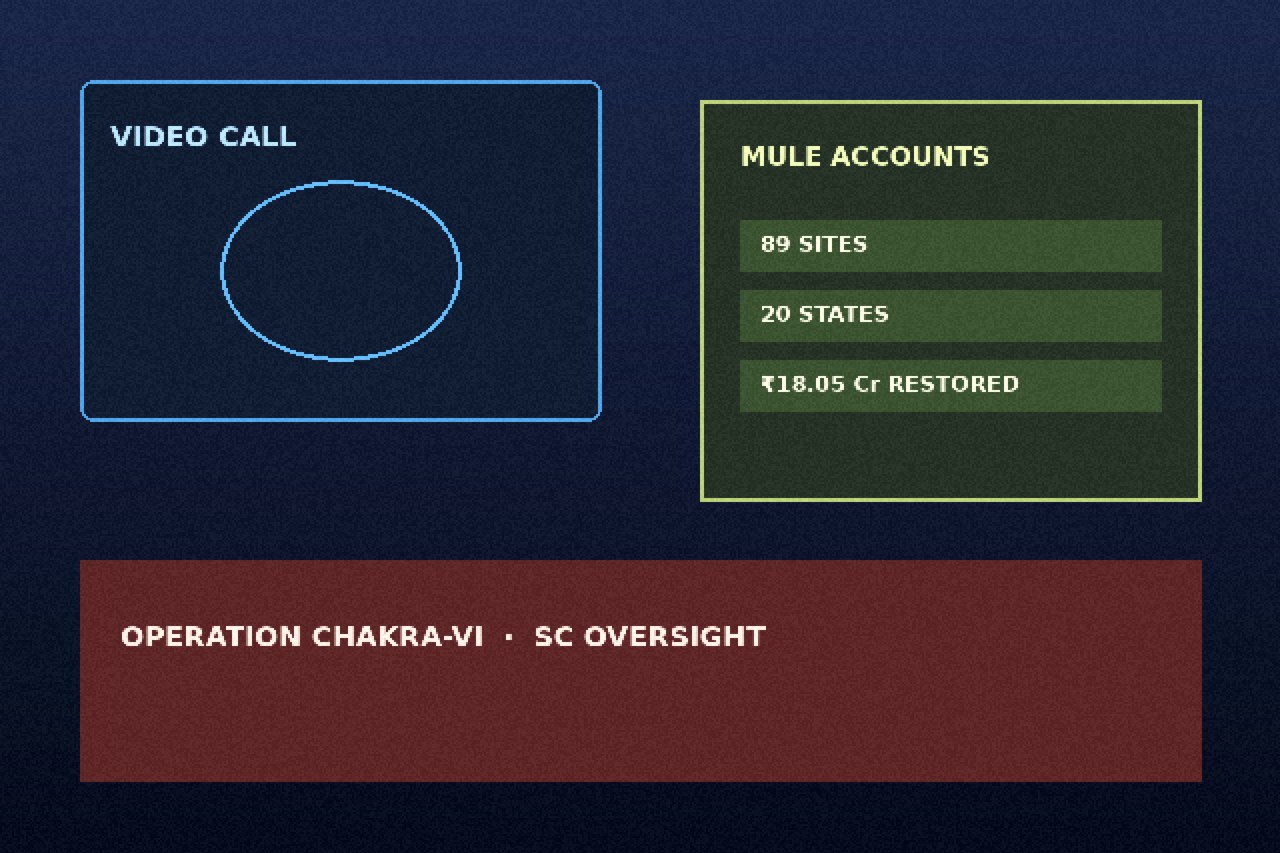
The Central Bureau of Investigation has widened its nationwide offensive against “digital arrest” fraud rings under Operation Chakra-VI, searching 89 locations across 20 States. Three accused were arrested in the latest round. The agency says the searches rest on bank records and digital account-access trails meant to show how proceeds moved and who ultimately benefited. The 5 September 2026 public record places that crackdown beside continuing Supreme Court oversight of the same menace.
Digital arrest scams coerce victims — often elderly people — into transferring crores after fraudsters claim, on video calls, that the victim is already under police or agency custody. A government submission to the Supreme Court earlier put total losses from such scams at roughly ₹3,000 crore. In December 2025 the Court gave the CBI a free hand to probe not only the scams but also bankers and mule-account networks that enable them, declaring that “enough was enough”.
Three cases illustrate the scale. A BITS पिलानी professor was held under a fabricated digital arrest for about three months and defrauded of ₹7.67 crore. Contacted in October 2023 by a caller posing as a telecom regulator, she was then taken over on Skype by persons posing as Mumbai police, Enforcement Directorate and CBI officials, falsely linking her to a money-laundering case involving Jet Airways founder Naresh Goyal. She was made to report daily movements and, believing funds needed “digital verification”, withdrew ₹7.67 crore through 42 transactions and deposited the money as directed — after also taking a bank loan of ₹80 lakh.
In the second case, a senior woman doctor in Gandhinagar, Gujarat, was kept under digital arrest from 15 March to 25 June. Fraudsters posing as a telecom official, police officer, prosecutors and a notary used forged papers purportedly linked to the ED. She broke fixed deposits, took loans, sold gold and shares, and transferred ₹19.24 crore to about 30 accounts. Police arrested one accused, Lalji Jayantibhai Baldaniya; investigators suspected a Cambodia-based cybercrime syndicate link.
In February–March 2026, 81-year-old businessman Ajit Gopalkrishna Saraf of Belagavi was cheated of ₹15.45 crore over about six weeks. A caller posing as a CBI official accused him of links with Mr Goyal; another posing as an RBI official forced liquidation of fixed deposits and stocks. The fraud surfaced when his son visited during Ugadi.
Among those arrested in the Chakra-VI round: Akash of Haryana, who received ₹1.95 crore into an account he opened and moved the money the same day; Raja Karmakar of Kolkata, accused of routing ₹1.5 crore through his firm’s account; and Jyoti Rani, alleged to have withdrawn part of credited funds in cash and transferred the rest onward.
The response architecture has grown under Court pressure. A Grievance Redressal Mechanism now covers more than 1.23 lakh bank branches across 69 banks. A Money Restoration Mechanism spans 57 banks and all States and Union Territories, having restored about ₹18.05 crore across 36,290 cases. On 4 August 2026 the Court directed the Centre, States, the RBI and telecom authorities to prepare a Standard Operating Procedure to curb digital-arrest scams, enable zero FIRs, and restore losses in a time-bound manner — including RBI procedures to freeze mule accounts and delayed-transaction safeguards. The Court has said a decline in reported fraud does not justify easing vigilance.
This cutting records institutional action and court directions, not a finished trial of every mule or overseas handler. The locked set is the 89-site search map, the three victim arcs, the three named arrestees in this round, the ₹3,000 crore loss figure as submitted to the Court, and the ₹18.05 crore restoration tally.
Comments