
They stamped it 100% pure. Police weighed 36 tonnes.
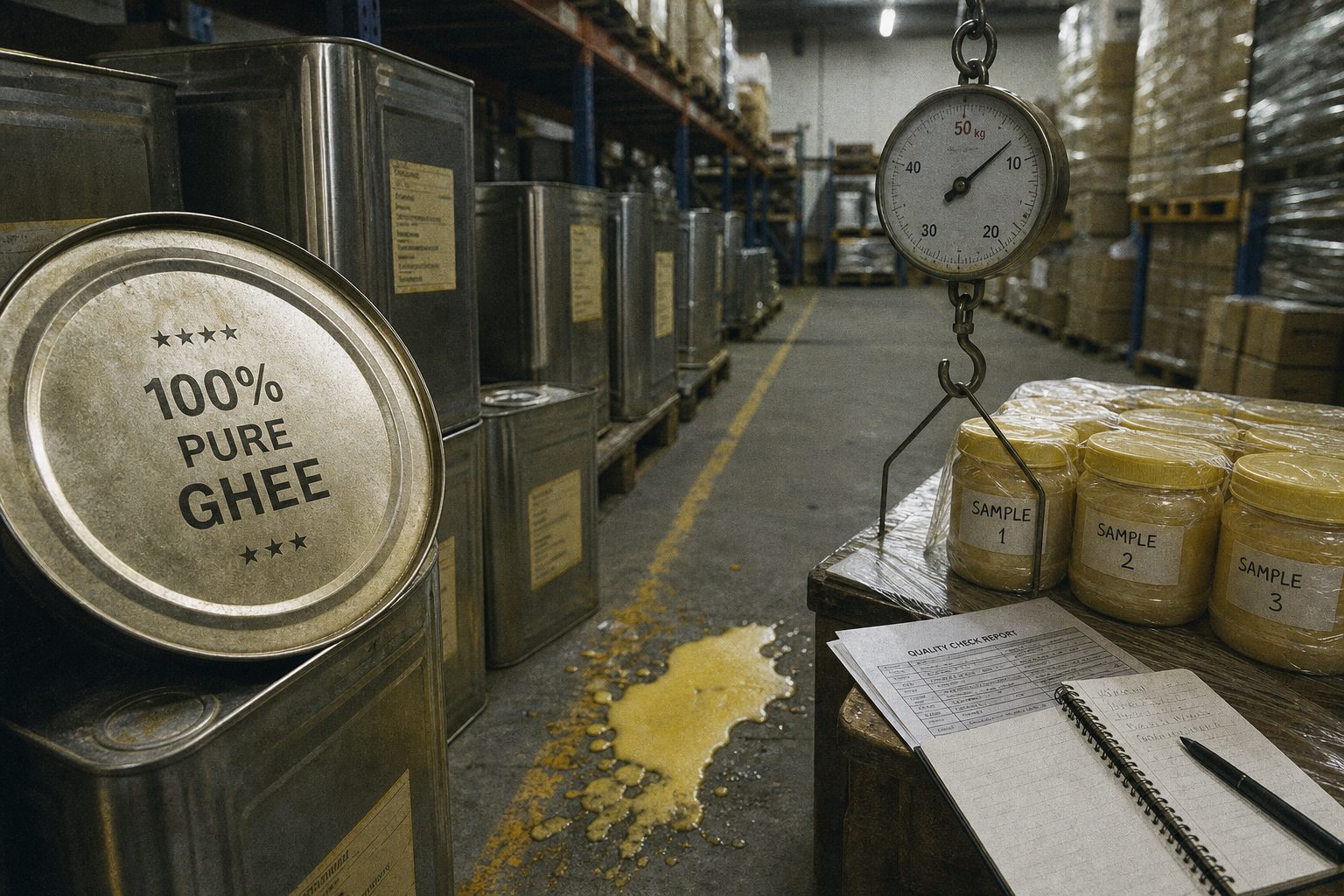
They printed 100% pure on a cover that would not even carry a licence number. Police then weighed the lie.
On Tuesday Hyderabad City Police and the Food Safety Department inspected 130 establishments — 39 ghee-making units and 91 selling points — and seized 36 tonnes of adulterated ghee and the stuff used to make it. Commissioner V.C. Sajjanar put the split on the table: 25.5 tonnes of the finished fake, 8.7 tonnes of cream, 1,200 litres of palm oil, 600 litres of vanaspati, 30 kilograms of starch, and six bottles of artificial ghee flavour. Statutory samples went to the laboratory. The stock went to Food Safety. The same haul was still Thursday’s civic lead.
The chemistry is not a rumour. Sajjanar described two recipes. In the first, there is no milk fat at all — palm oil, vanaspati and a flavour bottle made to smell like cow or buffalo ghee. In the second, skimmed milk powder with almost no fat is bulked with the same oils, starch and flavour so the paste still looks like ghee and still contains none. Task Force DCP Gaikwad Vaibhav Raghunath gave the honest arithmetic. Real ghee, he said, needs 30 to 35 litres of milk for one litre, and should cost more than ₹1,500 a litre once processing is counted. The adulterated tin was selling at ₹600 to ₹700. The gap is the profit. The profit is the public’s liver.
The public framing was Tirumala-style adulteration — the same insult that once attached to a temple kitchen. The police facts are plainer and wide enough. Sajjanar said the product was being sold as deepam and pooja ghee, and also to restaurants, tiffin centres, sweet shops, bakeries, caterers, Ayurvedic counters, dairy shops and hotels, including star hotels. It travelled Telangana and neighbouring States. The cream came from suppliers in Maharashtra, Uttar Pradesh, Madhya Pradesh, Gujarat, Karnataka and Tamil Nadu. A lamp in a house and a sweet on a plate used the same chemistry. That is the outrage. The police did not name a temple case or a brand. The labels they named were generic lies: “100% Pure Ghee,” “Premium Ghee,” “Farm Fresh Ghee,” “Natural Ghee,” often in transparent covers with no batch, no FSSAI number, no manufacture date, no expiry.
Adulteration, the commissioner said, ran from 10 percent to 40 percent, and the worse stuff went to the cheaper counter. DCP Gaikwad said 19 of 21 samples already back from a city NABL laboratory had failed. Genuine ghee is almost entirely milk fat. This was palm oil taught to pretend.
Sajjanar called food adulteration a public-health threat and asked people to buy only from licensed vendors, to check a seal and a licence, and to call 112 or the H-FAST helpline 8712661212. Identity, police said, would stay confidential. A helpline is useful. It is also an admission that the licensed shop was not the one doing the work.
36 tonnes is not a kitchen accident. It is a factory line that needed 130 doors opened on the same morning. Until Food Safety names the manufacturers and a court sees the lab sheet, Hyderabad’s “pure ghee” is a flavour bottle and a price that was always too low.













Comments