
A JCB ate the visa queue on Shantipath. The emblem on the gate was left standing.
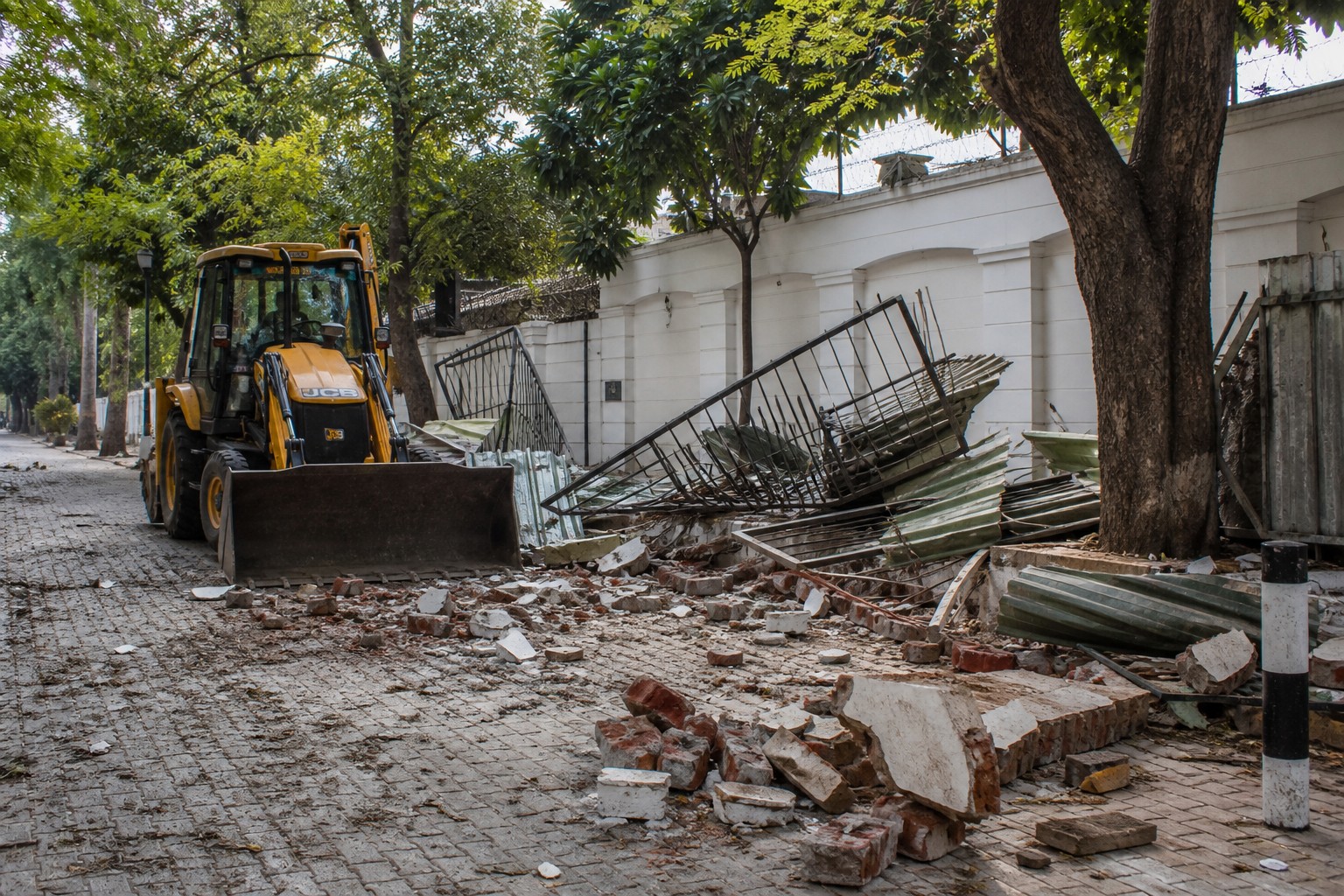
A JCB worked the public lane outside the Pakistan High Commission on Thursday. What it pulled down was queue furniture. What it left standing was the mission.
Indian authorities demolished unauthorised structures beyond the approved boundary of the High Commission in New Delhi on 20 August 2026. Official sources described the work that way. This desk does not have a Ministry of External Affairs quote to put on that sentence, and it will not invent one. The description that is public is enough: unauthorised, outside, beyond the line that had been approved.
The machine’s list was specific. Queue-management near the visa section. Barricades. Bollards. Roofing sheets. Metal railings. Those are the objects of a consular crowd, not of a chancery. People who come for a visa stand in a line. A line needs shade, a rail, a pole, a sheet. Thursday’s demolition treated that kit as construction that had crossed a boundary the host state had not signed.
The rubble matched the kit. Twisted frames. Bricks. Concrete. Plaster. In that debris the visa window labels were still readable: “Pakistani Passport Only,” and Window-5 visa applications. A demolition that leaves the service labels in the dust is not a rumour. It is a photograph of a counter that used to sit too far forward.
The main entrance was not in that photograph. White walls, domes, metal gates carrying the Pakistani emblem — that front was intact. The host state pulled the queue. It did not pull the gate. That distinction is the whole diplomatic grammar of the morning. A mission’s approved envelope is inviolable in ordinary practice. A shed, a rail, a bollard that has walked past that envelope is not the mission. It is a claim on the street.
The timing is not a mystery either, even without a named spokesman. Three days earlier Pakistan had removed security barricades and parking poles outside the Indian High Commission in Islamabad. Thursday in New Delhi followed that week. Official sources are the only attribution this desk will use for the Delhi side. The sequence is public. Tit-for-tat is the reading the sequence invites. A reading is not a communique.
Shantipath is a diplomatic road. Chanakyapuri’s missions live on the idea that the host polices the pavement and the guest polices the compound. When the pavement fills with a visa queue’s extra roofing, the host can say the compound has leaked. When the host answers with a JCB, the guest can say the pavement has been punished. Both sentences can be spoken without anyone quoting a foreign minister. Thursday’s facts support both and confirm neither as policy.
What the public can still see is the inventory. Barricades and bollards are security language. Roofing sheets and metal railings are crowd language. Together they are how a visa section manages heat and a line. Removing them does not close the High Commission. It changes how a passport-holder waits. The labels in the debris — Pakistani passports at one window, applications at Window-5 — are the civilian remainder of a diplomatic quarrel.
No official source, in the facts this desk holds, has said the main building was unsafe, or that the emblem was a target, or that visas have stopped. The entrance stands. The rubble is in the lane. Until someone who is allowed to speak for the Ministry puts a sentence on the record, Thursday is a JCB, a boundary, a three-day echo from Islamabad, and a pile of plaster that still says Window-5.
A host that demolishes only what sat beyond the approved line is making a legal point, not an architectural one. A guest that had just cleared poles from another capital’s gate will read that point as an answer. The street between those two readings is Shantipath. On Thursday the street was full of twisted frames. The gate with the emblem was not among them.







Comments